Table of contents
- The requirements that apply are the ones in place when you apply
- Why a 2022 month may not qualify in 2027
- Moving qualifying months to 2027 forms
- Which date goes on the new form
- If you do not know when you will apply
- The forms are kept, not submitted
- Your supervisor makes the call
- What to do now
- How this looks in FieldworkABA
If you expect to apply for BCBA certification on or after January 1, 2027, the fieldwork you count has to meet the 2027 requirements and be documented on 2027 forms. That includes hours you have already accrued, and months your supervisor has already signed on a 2022 Monthly Fieldwork Verification Form (M-FVF).
Those older months are not automatically lost. A month that meets the 2027 requirements can have its information transferred to a 2027 form. A month that does not meet them will not be fixed by moving it onto the new form. This article covers how to tell the difference, how the new form should be dated, and what to keep.
The requirements that apply are the ones in place when you apply
Which set of requirements your fieldwork is measured against depends on when you submit your application, not on when the hours were accrued. The BACB’s transition guidance puts it directly:
“All supervised fieldwork must meet the requirements in place at the time you submit your certification application.”
Guidance for Meeting the BCBA Requirements During the 2027 Transition, BACBThe cutoff is stricter than a submission date. For an application to be reviewed under the 2022 requirements, it has to be complete and already received:
“To be reviewed under the current 2022 requirements, your complete application (including payment and all required documents) must be received by December 31, 2026.”
2027 BCBA and BCaBA Requirements: What You Need to Know, BACBIf your application is not complete and received by then, the 2027 requirements apply.
Why a 2022 month may not qualify in 2027
Transferring a month is not just copying numbers from one form to another. The month itself has to meet the 2027 requirements. Here is how the monthly BCBA fieldwork requirements compare.
| Monthly requirement | 2022 | 2027 |
|---|---|---|
| Supervised Fieldwork | ||
| Fieldwork hours per month | 20 to 130 | 20 to 160 |
| Supervision | 5% | 5% |
| Individual supervision | At least 50% of supervision | At least 50% of supervision |
| Contacts with supervisor | 4 per month | Not required |
| Observation with a client | One per month | 60 minutes per month |
| Concentrated Supervised Fieldwork | ||
| Fieldwork hours per month | 20 to 130 | 20 to 160 |
| Supervision | 10% | 7.5% |
| Individual supervision | At least 50% of supervision | At least 50% of supervision |
| Contacts with supervisor | 6 per month | Not required |
| Observation with a client | One per month | 90 minutes per month |
Sources: the BACB’s transition guidance and the BCBA Handbook. The highlighted values are the only ones that got stricter.
Read the table closely and one row stands out. The monthly hour range got wider, the supervision percentage stayed the same or went down, the individual supervision rule did not change, and the monthly contacts requirement is gone. Observation is the requirement where a month that met the 2022 rules can still fall short in 2027.
Under the 2022 requirements a month needed one observation with a client, with no minimum length. Under the 2027 requirements what counts is the total time: at least 60 minutes a month for Supervised Fieldwork and 90 for Concentrated. A month with a single fifteen minute observation met the old rule and does not meet the new one.
“The 2027 requirements shift from contact-focused to duration-focused tracking. As a result, observations completed under the 2022 requirements may or may not meet the 2027 standards.”
Guidance for Meeting the BCBA Requirements During the 2027 Transition, BACBTransferring a month onto a 2027 form does not make that month compliant. The month must already meet the 2027 requirements, and the records behind it have to show that it did.
Moving qualifying months to 2027 forms
The monthly form has to match the requirements you apply under:
“If you apply under the 2022 requirements, you must maintain documentation using the 2022 M-FVFs. If you apply under the 2027 requirements, you must use the 2027 M-FVFs.”
Guidance for Meeting the BCBA Requirements During the 2027 Transition, BACBSo if you apply under the 2027 requirements and a qualifying month was signed on a 2022 M-FVF, its information needs to be transferred to a 2027 M-FVF.
Which date goes on the new form
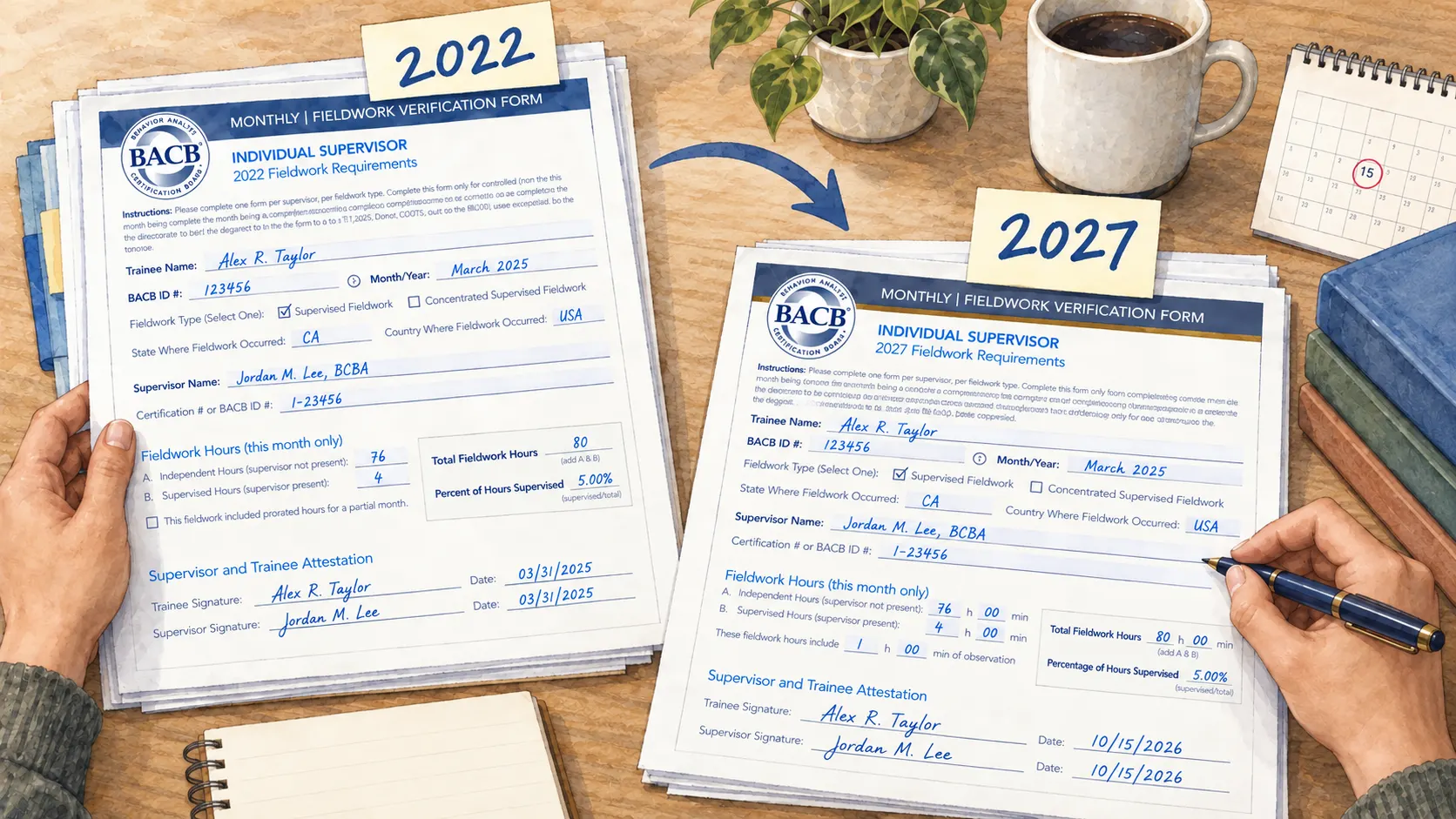
This is the detail that is easiest to get wrong. The transferred form keeps the original supervisory period, but the signature date is the date your supervisor actually signs the new form.
Suppose you completed qualifying fieldwork in March 2025 and it was documented on a 2022 M-FVF. If the information is transferred to a 2027 M-FVF in October 2026, the Month/Year field still says March 2025. Your supervisor’s signature on the new form carries the October 2026 date.
The BACB has advised that the new form should be signed with the date the corrections were made, and that documents should not be backdated. Dating the new form as though it had been signed in March 2025 would be backdating a signed document, which is a far more serious problem than having used the older form.
The two dates record different things. The supervisory period says when the fieldwork happened. The signature date says when your supervisor attested to it on this particular document.
If you do not know when you will apply
If your application could land on either side of the transition, the BACB recommends planning to meet both sets of requirements at once. That means:
- Meeting all components under both sets of requirements
- Completing documentation to meet both sets of requirements
- Keeping separate documentation systems that can show compliance in an audit, such as the duration of observations and the percentage of supervision
- Making sure all qualifying hours are accrued within five years
For the monthly forms, the recommendation is to complete both the 2022 and the 2027 M-FVF each month with your supervisor. In the guidance’s own words, “the easiest way to ensure compliance is to complete and retain both sets of forms while completing fieldwork.” Doing it month by month now is far easier than rebuilding years of forms at application time.
The forms are kept, not submitted
Monthly Fieldwork Verification Forms are not submitted with the certification application. You and your supervisor must retain all fieldwork documentation, including M-FVFs, for at least seven years and provide it to the BACB on request.
That is why a problem with an older monthly form can go unnoticed for years and then matter a great deal during an audit.
It is also why the records behind the form matter. A 2022 form shows that an observation happened. A 2027 form needs the number of minutes. To transfer a month, you need records that support that duration, which is why the BACB recommends tracking both the number of client observations and their duration in minutes during the transition.
Your supervisor makes the call
Fieldwork is evaluated when you apply, so there is no way to have a set of months approved in advance. The person attesting that each month met the requirements is your supervisor, whose signature is on the form.
Before transferring older months, go through them with your supervisor and agree on which ones the underlying records actually support.
What to do now
- Work out when you will apply for BCBA certification. If your complete application will not be received by December 31, 2026, plan for the 2027 requirements.
- Check each older month against the 2027 requirements. Go month by month rather than looking at your running total, and look hardest at observation minutes.
- Transfer the months that qualify onto 2027 forms. The hours and the supervisory period stay exactly as they were.
- Have your supervisor sign each new form with the date they sign it. Do not reuse the original date or backdate the new form.
- If your application date is still uncertain, complete both sets of forms from now on. This is the approach the BACB recommends during the transition.
- Keep the records behind the forms. You and your supervisor both need them for at least seven years.
Months that do not meet the 2027 requirements are a separate problem. Moving them onto a new form will not make them qualify. Review them with your supervisor while there is still time to plan around them.
How this looks in FieldworkABA
Steps 2 and 3 above are the slow part by hand, because they have to be done month by month. Here is how the same two checks look in FieldworkABA, a BCBA fieldwork tracker that checks each month of logged fieldwork hours against the requirements that apply to you.
1. Find the months that already qualify
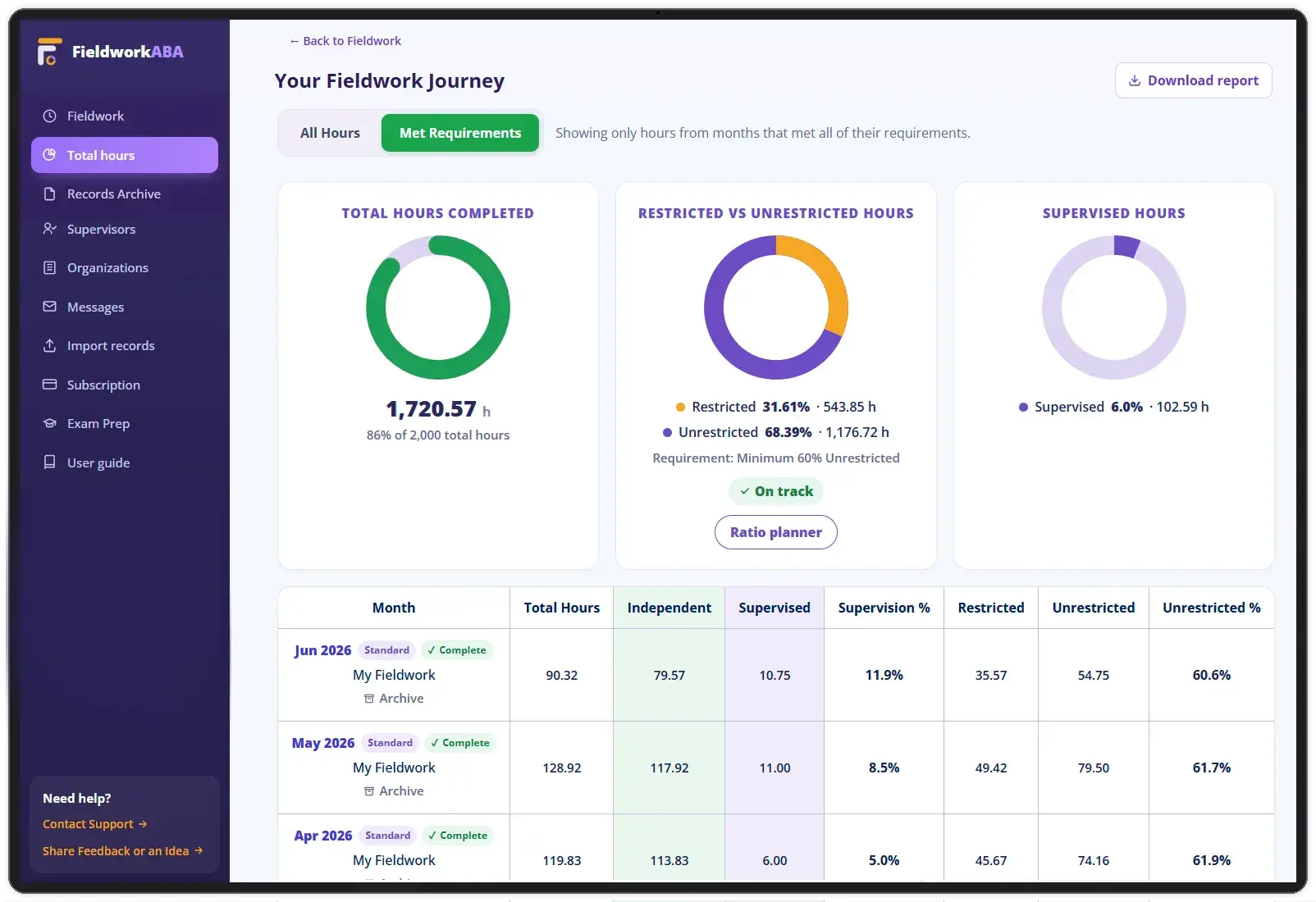
Total hours lists every supervisory period you have logged. The Met Requirements tab hides the months that fall short, so what is left is the set that already satisfies the standard that applies to you. Those are your transfer candidates.
2. Switch to 2027 and see what a month is missing
The requirements that FieldworkABA checks against come from a single setting. Under Fieldwork Profile, choose when you plan to apply: Before January 1, 2027 or On or After January 1, 2027.
When you change this setting, FieldworkABA rechecks every month against the corresponding set of requirements, one requirement at a time.
Here is the same Concentrated month under each setting. The hours themselves do not change.


Under the 2022 requirements this month passes everything: 32.51 hours, 22.3% supervision against a 10% minimum, 7 contacts, and 5 observations with a client. Under the 2027 requirements the hours and supervision still pass, with the minimum now 7.5%. The contacts check is gone, and in its place is observation time: 90 minutes are needed, and none are recorded.
So this month is short of one thing only: its observation time in minutes. The 2022 rules asked only whether an observation happened, so many trainees never recorded how long it lasted.
If your records show that the observations in that month added up to at least 90 minutes, open the supervised entries where your supervisor observed you with a client and fill in Observation time with client (minutes). Once the month’s total reaches 90 minutes, it meets the 2027 requirements. For Supervised Fieldwork the threshold is 60 minutes.
Enter only the time that was actually observed. If the real observation time falls short, the month does not qualify under the 2027 requirements, and that is a month to talk through with your supervisor.
Once the minutes are in, go back to Total hours. With the setting on 2027, the Met Requirements tab lists exactly the months that qualify under the 2027 requirements, which are the ones ready to move onto 2027 forms.
The same setting decides which form is generated, so with it on 2027 your monthly verification forms come out on the 2027 M-FVF. Your supervisor still signs each one with the date they actually sign it.
Know which months would pass
FieldworkABA checks each supervisory period against the fieldwork requirements that apply to you, so you can see month by month whether your record meets the applicable thresholds. For trainees preparing for the 2027 transition, that makes it easier to identify which older months need attention before application time rather than discovering the issue later.
Start Free What changes in 2027Sources
- Guidance for Meeting the BCBA Requirements During the 2027 Transition, BACB, updated 01/2026.
- 2027 BCBA Requirements, BACB.
- 2027 BCBA and BCaBA Requirements: What You Need to Know, BACB.
- BCBA Handbook, BACB, updated 06/2026.